
An online shop in the automotive sector from Poland’s Tricity (the Gdańsk–Gdynia–Sopot area), selling oils, filters and similar accessories, has been buying boxes straight from the manufacturer for 5 years. It began with a search for a cheaper alternative to 3-ply boxes. Along the way we jointly solved the problem of liquids getting broken in transit, changed the board flute from BC to EB (a saving of a few per cent) and rotated the box dimensions without changing its capacity (a reduction of between ten and twenty per cent). Today we hold a stock of three sizes for the customer with 24 h call-off and deliver 2–3 pallets several times a month via a pallet carrier – because the customer has little warehouse space.
This description is anonymised: we do not give the company’s name. Status as at November 2026.
The customer described operates in Poland. Delivery within 24 hours of call-off applies to our own transport within Poland; to customers abroad we ship pallets by freight forwarder or as a full truckload, and the delivery schedule is agreed in the quotation.
The case in brief
| Customer | an online shop in the automotive sector from the Tricity area (oils, filters and similar accessories); in the business for over a decade |
|---|---|
| Cooperation | for 5 years; it began with a search for a cheaper alternative to the 3-ply boxes the shop was buying |
| Supply model | a stock of three repeat sizes in the manufacturer’s warehouse; 24 h call-off; full pallets only, one size per pallet |
| Deliveries | pallet carrier, 2–3 pallets per delivery, several times a month – matched to the customer’s small warehouse |
| Design optimisations | 3-ply board → 5-ply BC board (no more broken shipments) → EB flute (thinner, higher ECT value): a saving of a few per cent; dimensions rotated from 350 × 300 × 150 mm → 350 × 150 × 300 mm at the same capacity: a reduction of between ten and twenty per cent |
| Invoicing | one consolidated invoice per month, with deferred payment terms |
| Stock arrangements | a partnership-based arrangement: the customer commits to taking the stock, and we keep the stock at the agreed level and adjust it in line with consumption |
The start: a cheaper alternative to the 3-ply box
The customer has been in the automotive trade for over a decade and sells, among other things, oils, filters and accessories by mail order. For packing it used standard regular slotted boxes made of 3-ply (single-wall) board, bought from online packaging shops. It came to us the way many customers do: it was looking for a cheaper source of exactly the same boxes. At first we simply produced them for the customer – to the existing specification.
The problem: liquids broken in transit
It soon turned out that the real cost was not the price of the box but the complaints. The shop’s customers were reporting cans and canisters of oil and service fluids broken in transit. Liquids are heavy products, and a box made of 3-ply board was simply too weak for them – regardless of who had made it.
The customer found a box online made of 5-ply (double-wall) board with BC flute. The problem of broken shipments disappeared, but a new one appeared: cost. BC board is thick, so the boxes take up a lot of space in transit and in the warehouse, and the material itself is more expensive.
Optimisation no. 1: EB flute instead of BC
This is where the work began that an online packaging shop will not do, because it sells what it has on its shelves. As the manufacturer, we proposed changing the flute from BC to EB: EB board is noticeably thinner, so the same boxes take up less space on the pallet and in transit, and the EB board we selected also had a higher ECT value (edge crush resistance) than the BC used before.
The effect was immediate: a saving of a few per cent on every order, with no loss of protection for the heavy liquids.
Optimisation no. 2: the same litres, a smaller sheet
The second move was even simpler. The customer was using a box measuring 350 × 300 × 150 mm, found online at some point. We proposed changing the order of the dimensions to 350 × 150 × 300 mm – that is, moving the flaps to a different side of the box. The capacity of the box stayed identical; all that changed was which edge is the height.
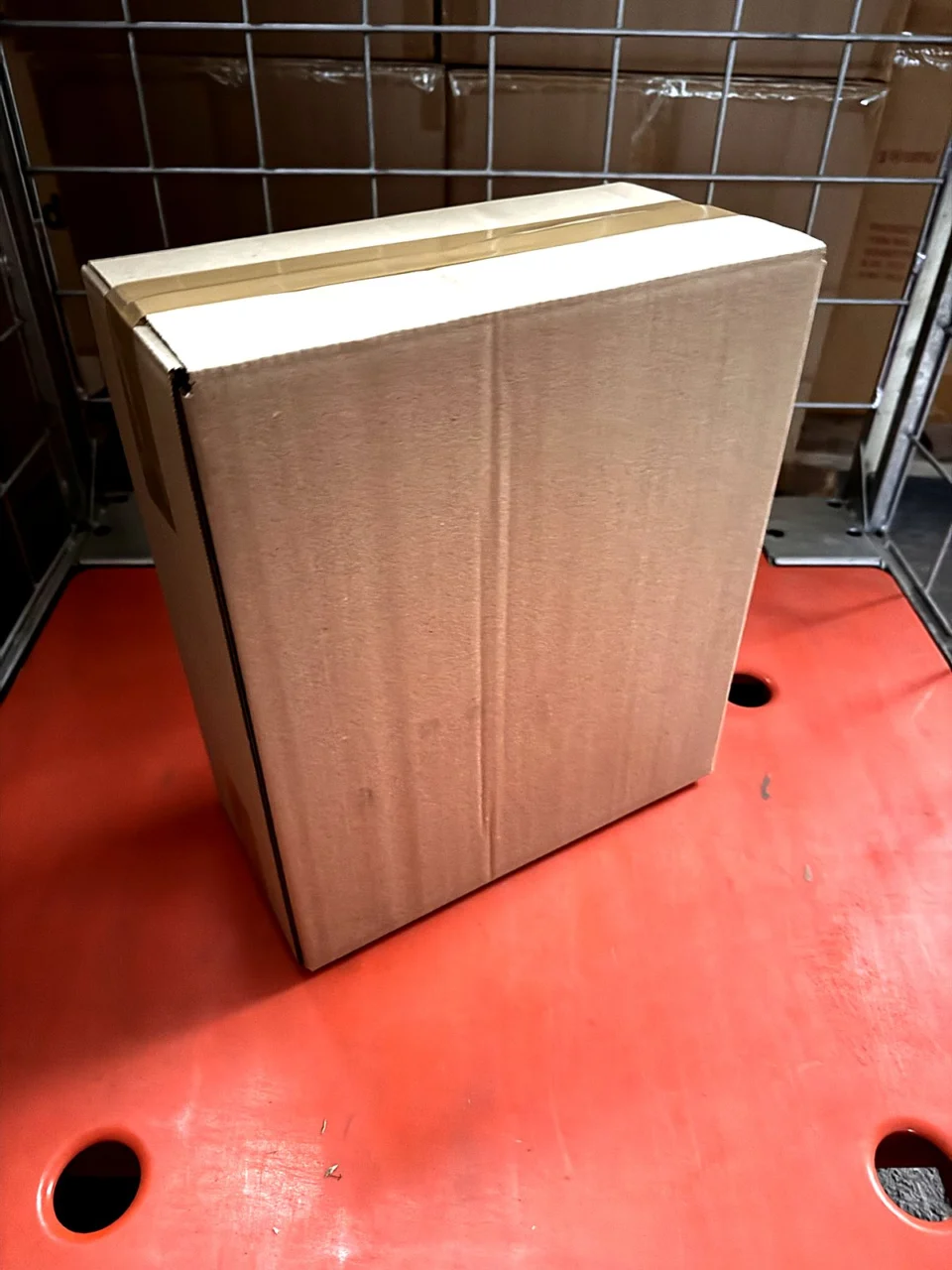
Why does this work? In a standard regular slotted box the flaps close across the width. When the width drops from 300 to 150 mm, the flaps are half as long, so between ten and twenty per cent of the material ‘disappears’ from the board sheet – at the same box capacity. A smaller sheet also means more economical transport.
For the customer this meant a reduction in the box price of between ten and twenty per cent; the bonus is practical – shorter flaps are easier to fold, and the taller box comfortably holds bottles and canisters standing upright.
The model today: stock at the manufacturer, 24 h call-off
The shop has little warehouse space – every pallet of boxes set aside ‘as a reserve’ is a pallet with no goods on it. That is why the stock lives with us:
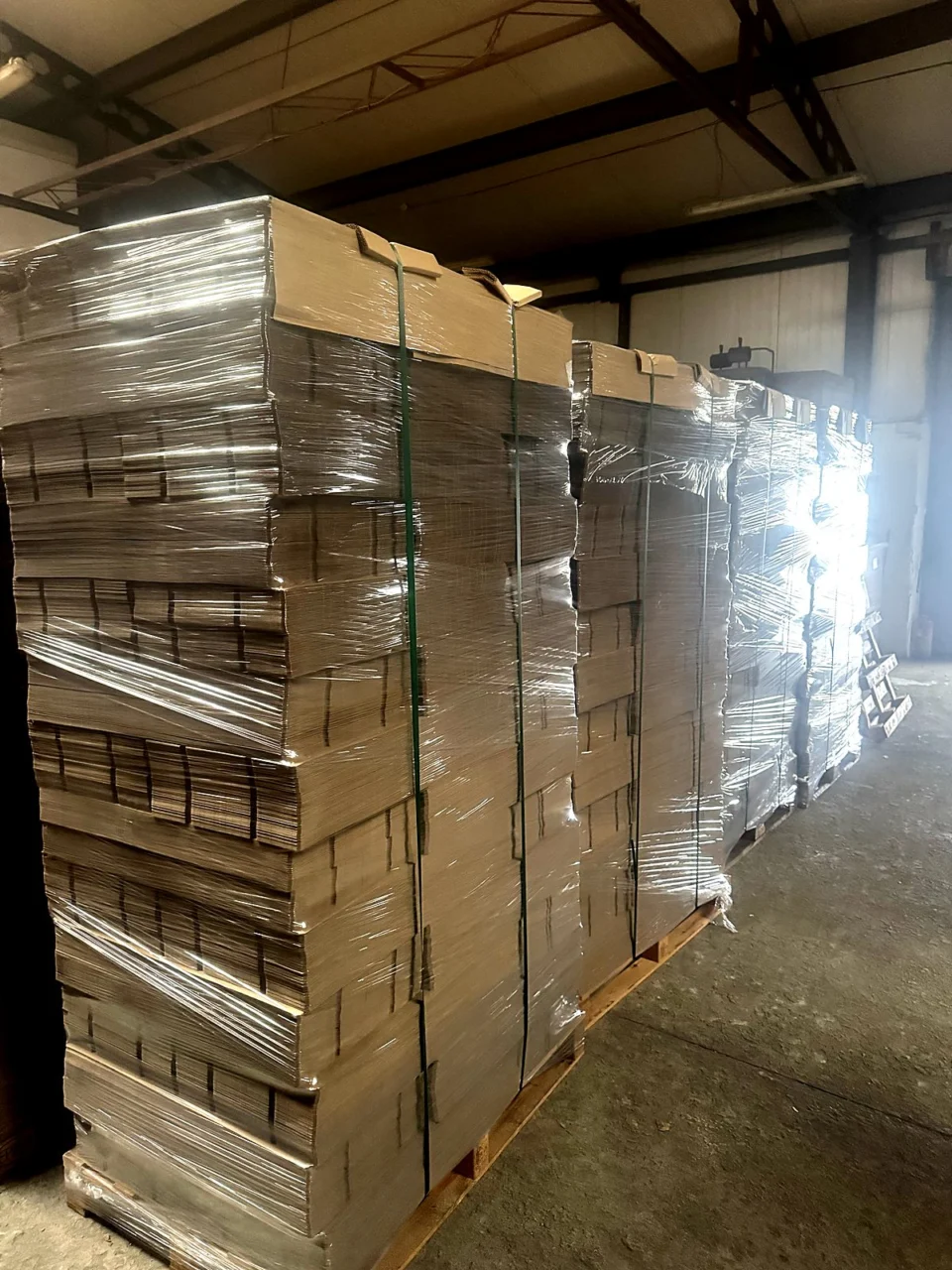
- Three repeat sizes wait, already produced, in our warehouse, in the agreed quantity.
- 24 h call-off. When the customer needs boxes, it calls off a delivery from the stock – the goods are picked from the shelf and do not wait for production. How this mechanism works is described in our guide to delivery models with call-off stock held at the supplier.
- Full pallets only, one size per pallet. This is a joint arrangement: uniform pallets lower our costs of storage and dispatch preparation, which means the customer buys at a lower price, and unloading at the customer’s end takes a moment.
- Pallet carrier, 2–3 pallets, several times a month. Instead of infrequent large deliveries – a small, regular rhythm matched to a tight warehouse.
Four differences compared with an online box shop
1Certainty of availability instead of ‘whatever is on the shelf’
We keep the stock at the agreed level. When the customer plans higher consumption, it tells us in advance and we increase the stock ahead of time. When consumption jumps unexpectedly, we replenish the stock within a few days, because we make these boxes ourselves. In an online shop, a sold-out item usually means a wait counted in weeks or a search for a substitute with different dimensions.
2Advance information about market changes
As a manufacturer we know about changes in the prices of raw material and finished packaging at least a month in advance – and we give the customer the same notice. This makes it possible to react together: at the customer’s request we increase the stock on the existing terms, so that the price increase is spread over time. A buyer in an online shop learns of an increase from the new price list – and is presented with a fait accompli.
3Peak season without the lottery
In a busy period, for example before Christmas, the customer can be sure that its boxes are physically waiting in our warehouse, because that is the stock we agreed. In online packaging shops orders are served in the order they arrive, and the end of the year is when packaging most often runs short.
4One invoice a month instead of payment per shipment
The customer receives one consolidated invoice once a month, with deferred payment terms. When buying from online shops, it mostly paid for each shipment separately – and every payment is a separate transaction to describe and post in the accounts.
What this means for an online shop
- Work out the cost of complaints, not just the price of the box. The lowest-priced box in which products get broken is the most expensive element of the shipment.
- Not every 5-ply board is the same. Changing the flute while keeping (or even raising) the ECT value can immediately lower the cost of purchase and transport.
- Check the order of the dimensions. The same box with the flaps on the shorter side can use between ten and twenty per cent less board at identical capacity. For help deciding how many boxes to order and in which sizes, see what affects the price of custom-size boxes.
- Keep your stock at the manufacturer, not in your own warehouse. Space in a mail-order shop is for goods; boxes can wait at the supplier with 24 h call-off.
- Tidy up your invoicing. One consolidated invoice a month simplifies bookkeeping compared with paying for each shipment separately.
This is the second case study from our practice – the first describes a staged change of box supplier in series production, the third – corrugated inserts instead of foam at an electronics manufacturer, and the fourth – can trays for a pet food manufacturer from Lublin.
Frequently asked questions
What is a call-off from stock?
It is a delivery of boxes that have already been produced and are waiting in the agreed stock in our warehouse. We fulfil a call-off within 24 hours, because the goods do not wait for production – they are picked from the shelf.
Do I have to order full pallets?
In the model described, yes – it is a joint arrangement. Full, uniform pallets (one size per pallet) lower our costs of storage and dispatch preparation, which means the customer buys at a lower price.
What happens when box consumption rises unexpectedly?
We replenish the stock within a few days, because we make the boxes ourselves. When the increase is planned, for example before the season or a promotion, the customer lets us know earlier and we increase the stock in advance.
Does holding stock require a contract?
The rules are simple and based on partnership: the customer commits to taking the agreed stock, and we keep it at the agreed level and adjust it when consumption changes. In this cooperation, for five years neither side has needed anything more than the other’s word.
How are deliveries invoiced?
The customer receives one consolidated invoice once a month, with deferred payment terms – regardless of the number of deliveries in that month.
What is the difference between EB and BC flute?
Both are 5-ply boards, but EB combines the fine E flute with B flute and is noticeably thinner than BC. Thinner board means less box volume in transit and in the warehouse. In the project described, the EB board selected also had a higher ECT value, i.e. edge crush resistance, than the BC used before. The choice of flute always depends on the product and the shipping method.
From what scale does stock at the manufacturer make sense?
Usually from a few pallets a month, but we set no threshold. Tell us how many boxes you use and together we will work out whether this model would be advantageous for you.
Do you run an online shop and want to cost your own scenario?
Send us your box dimensions and approximate monthly consumption, and we will propose a design, a flute and a delivery model – we will prepare a quotation within a few hours.
Kartoniki.eu (LOFREE Sp. z o.o. sp. k., Lubartów, Poland) is a manufacturer of corrugated board packaging: we have been manufacturing in-house since 2019, in a production hall of over 3000 m², for several hundred companies. More about the company: about Kartoniki.eu.
