
An electronics manufacturer that makes prefabricated assemblies, controllers and display modules for agricultural machinery manufacturers has, for about half a year, been packing its products in layered nests made of corrugated board instead of cut foam bought from a separate supplier. The cushioning is between ten and twenty per cent cheaper, space has been freed up in the warehouse (the inserts arrive flat-packed, as needed, with no stock held), and the packaging records are simpler, because the whole pack falls into a single material category.
This description is anonymised: we do not give the company’s name or region. Status as at November 2026.
The customer described operates in Poland. Delivery within 24 hours of call-off applies to our own transport within Poland; to customers abroad we ship pallets by freight forwarder or as a full truckload, and the delivery schedule is agreed in the quotation.
The case in brief
| Customer | electronics manufacturer; its customers are agricultural machinery manufacturers (prefabricated assemblies, controllers, display modules) |
|---|---|
| Before | nests cut from foam, bought from a separate supplier; the biggest problem: the space taken up by the foam stock in the warehouse |
| After | layered nests made of corrugated board, cut to the outline of the component; one insert holds one component |
| Delivery model | as needed, to order – no permanent stock; the inserts arrive flat-packed |
| Results | cushioning between ten and twenty per cent cheaper; no more separate foam store; one material category in the packaging records |
| Since when | for about half a year |
The customer and the product: unforgiving electronics
The customer’s products go to agricultural machinery manufacturers: prefabricated assemblies, controllers and display modules, which are then fitted in cabs and control boxes. Mechanically, the most sensitive parts are the screens and connectors. A component that slid around the box in transit, or pressed its display against a wall, came back as a complaint, which is why from the outset they were packed in cut-out nests. The first ones were made of foam.
The starting point: foam from a separate supplier
Mechanically the foam did its job, but it generated two costs that do not show up in a price list. The first is space. A stock of cut foam shapes and foam blocks is bulky, cannot be folded flat, and took up warehouse space that production needed for products. The second cost is a second purchasing stream, because a separate cushioning supplier alongside the box supplier means separate orders, deliveries and invoices to keep track of.
What we proposed: a layered corrugated nest
We transferred the working principle of foam to corrugated board. We glue several layers of board into a block and cut an opening in it to the outline of the specific component, while the bottom layer stays solid and acts as a cushioning base. The component is inserted as if into a mould. The nest holds it by its outline, and the display touches no wall. One insert holds one component.
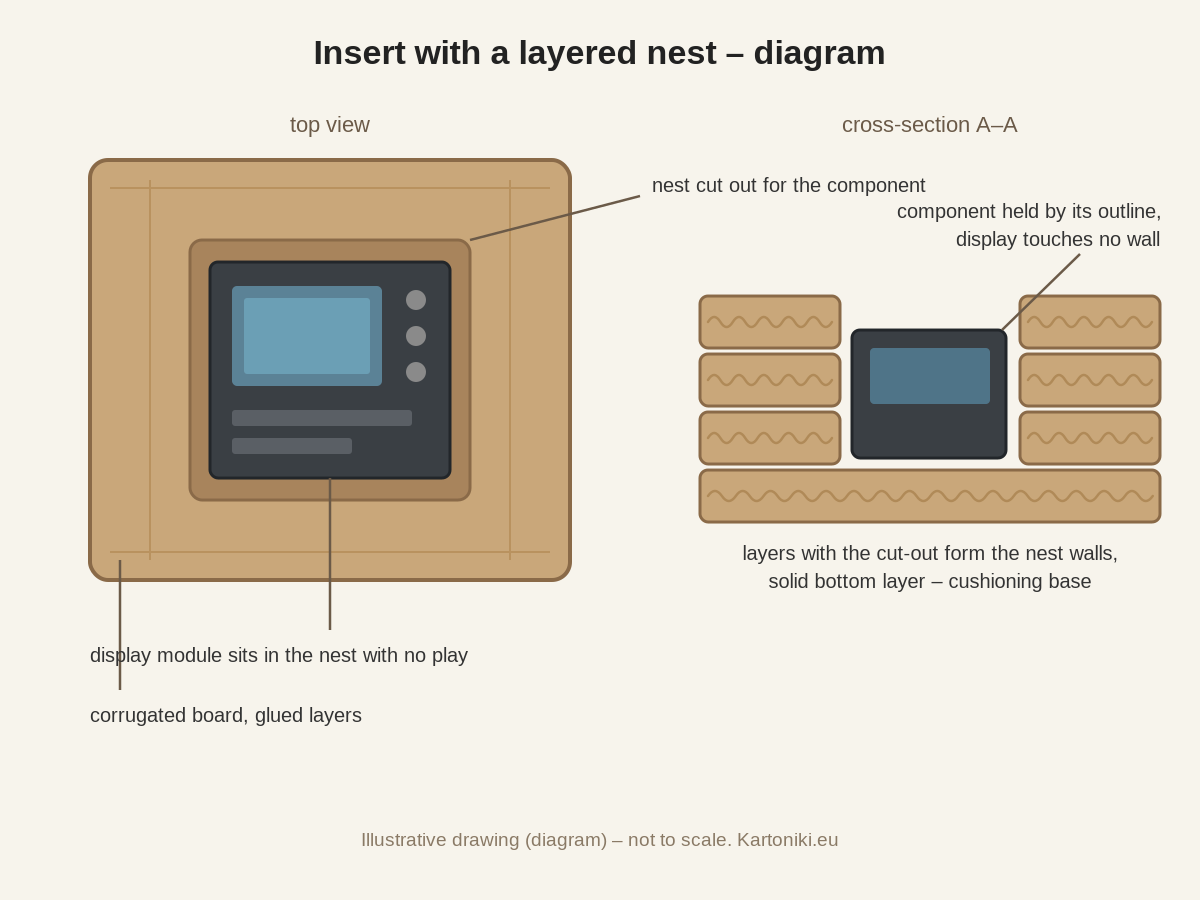
In cost terms, the corrugated cushioning came out between ten and twenty per cent cheaper than the previous foam, while doing the same job in the pack.
What did not work the first time
The first version of the nests was designed for the most frequently shipped components. In practice there were more models and outlines than the first design covered, and some components fitted the nests only ‘almost’. We went back to the drawing board and improved the fit by extending the cut-outs so that the family of inserts handles a larger number of different components and models. The set was complete only after this round of samples. This is a typical stage when switching cushioning, and it is better to build it into the plan from the start than to be caught by surprise.
Warehouse and deliveries: flat, as needed
In this project there is no permanent stock – the customer orders inserts for current needs, and they arrive flat-packed. The separate foam store has disappeared, and the cushioning no longer competes with products for space. This is a different model from our automotive shop case study, where stock is held at the manufacturer with 24 h call-off. We match the model to the customer’s rhythm of consumption, not the other way round.
A surprising angle: BDO records (the Polish waste and packaging register)
In packaging records each component is accounted for by type of material. Foam cushioning belongs to the plastics category, and the box to the paper and cardboard category. Once the cushioning is switched to corrugated board, the whole pack counts in a single material category, with one source of weight data – on request we prepare for customers a summary of the weights of the packaging bought from us, straight from our system. A caveat: we are not legal advisers, and the rules on extended producer responsibility are in the process of changing – confirm the classification and rates in the BDO system or with your adviser.
Four differences compared with foam from a separate supplier
1One stream of deliveries and invoices
The box and the cushioning can be ordered from one supplier, in one rhythm, so there are fewer orders, deliveries and documents to keep track of.
2Warehouse: flat instead of bulky
Corrugated inserts arrive and wait flat-packed; foam shapes take up volume from day one.
3Designed for the specific component
The nest holds the component by its outline, and sensitive areas, e.g. the display, do not touch the walls. When the model changes, we add a cut-out to the family of inserts.
4Records in one category
The box and the cushioning are in the same material category of the packaging records, with one source of weight data.
What this means if you pack in foam
- Work out the full cost of foam. To the price on the supplier’s price list add the warehouse space and the second purchasing stream.
- Start with one product. Ideally the one that generates complaints or takes up the most space in the packing area.
- Plan a fitting round. The list of ‘all models’ almost always turns out to be longer than at the start. A second iteration of samples is a normal stage of the project, not its failure.
- Match the delivery model to consumption. As needed and without stock, as in this case, or with stock and 24 h call-off for a large, steady volume.
For typical cushioning switches, from bubble wrap to foam, see our comparison of void fill and protective packaging. Other case studies from our practice are a staged change of box supplier, boxes for an automotive online shop and can trays for a pet food manufacturer.
Frequently asked questions
What is a layered corrugated nest?
It is an insert glued together from several layers of corrugated board, in which an opening is cut to the outline of the product; the bottom layer stays solid and acts as a cushioning base. The product is placed in the nest as if in a mould – it lies immobile, and sensitive areas do not touch the walls of the box.
Does a corrugated insert protect as well as foam?
With the right design – for the specific product, its weight and its transport route – a corrugated insert takes over the mechanical role of cut foam, as the project described shows. Antistatic protection is a separate matter: it is provided by the ESD bags and materials in which electronics are packed, regardless of whether the cushioning is foam or corrugated board.
What does switching the cushioning change in BDO?
Packaging components are accounted for in the records by type of material: foam cushioning goes into the plastics category, and the box into paper and cardboard. Once the cushioning is switched to corrugated board, the whole pack counts in a single material category, and on request we prepare for customers a summary of the weights of the packaging bought from us, from our system. This is not legal advice – confirm the classification and current rates in the BDO system or with your adviser, because the rules on extended producer responsibility are in the process of changing.
Do I have to order a stock of inserts?
No. The customer described orders inserts as needed, with no permanent stock – they arrive flat-packed together with the order. For companies with large, repeat consumption we also run a model with stock at the manufacturer and 24 h call-off.
How many components does one insert hold?
In this project one insert holds one component – the nest is cut to its outline. We also design multi-component inserts: cell dividers, partitions and nests for sets; you will find an overview of the solutions on our page on inserts, dividers and product protection.
Packing your products in foam and want to cost a corrugated option?
Send us the dimensions or a photo of the product and the current cushioning, and we will propose an insert design and prepare a quotation within a few hours.
Kartoniki.eu (LOFREE Sp. z o.o. sp. k., Lubartów, Poland) is a manufacturer of corrugated board packaging: we have been manufacturing in-house since 2019, in a production hall of over 3000 m², for several hundred companies. More about the company: about Kartoniki.eu.
